

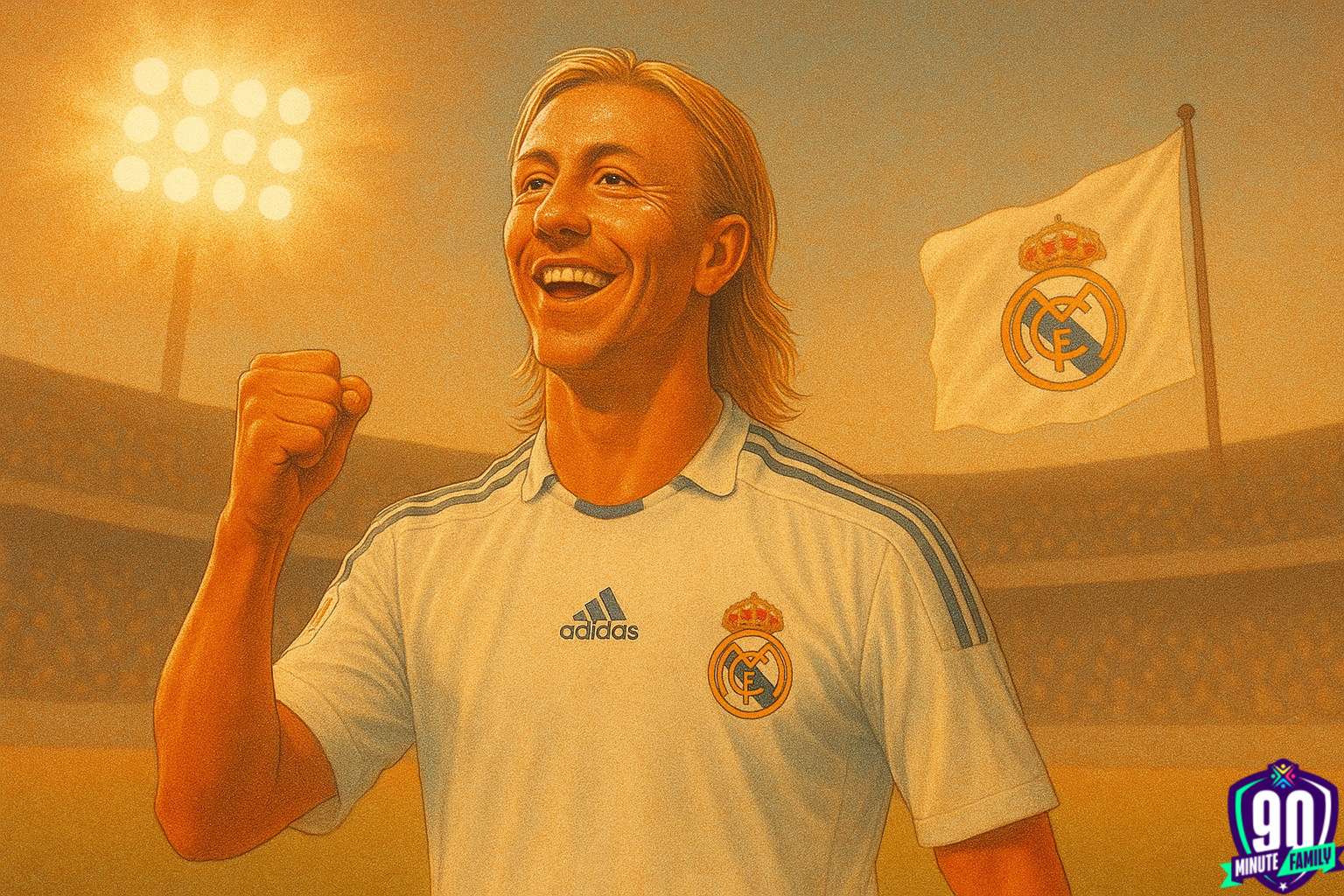

Raised in white: the boy from the cantera
José María Gutiérrez Hernández, better known as Guti, is one of the most fascinating figures in modern Spanish football. Not because he was the most disciplined. Not because he always performed at the highest level. But because he represented something rare at a club like Real Madrid: a self-developed player with complete artistic freedom and an uncompromising personality.
Guti was born in 1976 in Torrejón de Ardoz, just outside Madrid, and joined Real Madrid's youth academy at the age of eight. He grew up in the club's system, with the Santiago Bernabéu as his natural goal in life. In December 1995, he made his debut for the first team, aged just 19, and immediately made his mark with a goal. It was a moment that signalled that this was no ordinary academy player. Guti had something extra – a mix of technique, arrogance and creative freedom that set him apart from the crowd.
Early on, he became known as a player with exceptional ball control and passing repertoire, but also as a player who demanded trust. He was not the type to be put into a rigid system. Guti had to be given space. Freedom. And when he got it, he could be spectacular.
The breakthrough and the first heyday
In the late 1990s and early 2000s, Guti gradually took on a more prominent role in the team. Under Vicente del Bosque, he was used as both an attacking midfielder and a winger. His breakthrough came in the 2000/01 season. When striker Fernando Morientes was injured, Guti was moved forward – and responded by scoring 14 league goals. It was his most prolific season, and he became a key player in Real Madrid's La Liga title.
This period clearly showed Guti's potential. He was not only a passer, but also an intelligent finisher with good timing in the box. At the same time, he was already a player who created debate. Some thought he was a genius. Others thought he was too uneven. The truth was that he was both – and that's exactly why he became interesting.
Guti was never the most athletic player. Nor was he the most willing to run. But he thought faster than most, and he had a football understanding that allowed him to dictate the pace and direction of matches when he was in the mood.
The Galácticos era: talent in the shadow of the stars
As Real Madrid entered their famous Galácticos era, Guti's role changed dramatically. The club brought in superstars like Zinedine Zidane, Luís Figo, Ronaldo and later David Beckham. Suddenly, the competition was fierce. Guti, who had already established himself, was once again pushed around the system to make room for the big names.
He played wherever he was assigned – central midfielder, attacking midfielder, deep playmaker, winger, hanging striker – but the lack of a fixed role marked his career. Guti himself was open about his frustration. He often joked that every time he found his rhythm in midfield, the club bought a new Galáctico to take his place.
Yet he chose to stay. Time and time again. The offers from other clubs were there. He could have been a leading player somewhere else. But Guti was Real Madrid. And Real Madrid was Guti. It was perfectly summed up in his most famous quote:
“Playing 30 minutes for Real Madrid is better than 90 minutes for any other club.”
For the fans, this was gold. In a club where players often came and went, Guti was a constant element. A reminder of the club's roots in the midst of stardom.
The Magician: The Passes, the Heels, and the Moments
What has truly secured Guti's cult status are the moments. Not the statistics. Not the international numbers. But the moments that made people stand up from their seats.
Guti was an artist with the ball. He delivered passes that broke the logic of football. No-look passes. Passes with the outside of the foot. Chip. Sticks through joints. And not least: the heel kicks. He used his heel like others used the inside of the foot.
The most iconic moment came in 2010 away to Deportivo La Coruña. Guti was played through alone with the goalkeeper. Everyone expected a finish. Instead, he put the goalkeeper down with a shot - and back-heeled the ball to Karim Benzema, who scored into an open goal. A completely unnecessary, but completely brilliant choice. The moment was dubbed "God's back-heel kick" and remains one of the most played clips in La Liga history.
This was Guti in a nutshell. He did the unexpected. Sometimes bordering on the irresponsible. But always with an idea.
Temperament, controversies and humanity
Guti was never a perfect professional. He had a temper. He had short fuses. And he had several moments that gave the critics ammunition.
He could disappear mentally in matches. He could lose his temper. He got red cards he didn't need. In some situations he crossed the line. The episode against Sevilla in 2009, where TV footage suggested he spat at an opponent, became a low point and an example of Guti's bad side.
Off the field, he was just as colorful. He embraced the celebrity life. Nightlife. Fashion. Hairstyles. He was never afraid of the spotlight. For some, this became a symbol of a lack of seriousness. For others, it made him more human.
Fabio Capello's time as coach illustrates this well. Capello, known for his discipline, was often at odds with Guti. Once Capello asked the players to wait on the training pitch while he himself arrived late – to test their discipline. Everyone stood neatly in the centre circle. Everyone – except Guti, who stood in the shadows and waited. Typical. A little lazy. A little rebellious. A little Guti.
The leadership role and maturation
Over the years, Guti matured. He became vice-captain behind Raúl. An experienced voice in the dressing room. Although he never became the clear leader who shouted the loudest, he led through experience and club understanding.
He was the link between generations. Between Zidane and the younger ones. Between the Galácticos and the cantera. When he played, he represented the club's identity in a way few others did.
The farewell and life after Real Madrid
In 2010, Guti said goodbye to Real Madrid after 15 seasons in the A-team. Over 500 matches. Five La Liga titles. Three Champions League trophies. The numbers were impressive, but the applause he received at the farewell was even more telling.
He went on to Besiktas, where he rounded off his career with a final burst of creativity before hanging up his boots. But in Madrid he had already become immortal.
Why Guti is a cult hero
Guti never became a Ballon d'Or candidate. He never became a regular fixture in the national team. But he became something else: a cult hero.
Because he was loyal in a disloyal time.
Because he was creative in an increasingly mechanical world of football.
Because he dared to fail spectacularly – and succeed even more spectacularly.
He wasn't always loved. But he was never forgotten.
For Real Madrid fans, Guti will always be the symbol of freedom, talent and the slightly dangerous art of football. The player who could drive you crazy one weekend – and make you fall in love with the game the next.
This was Guti.