

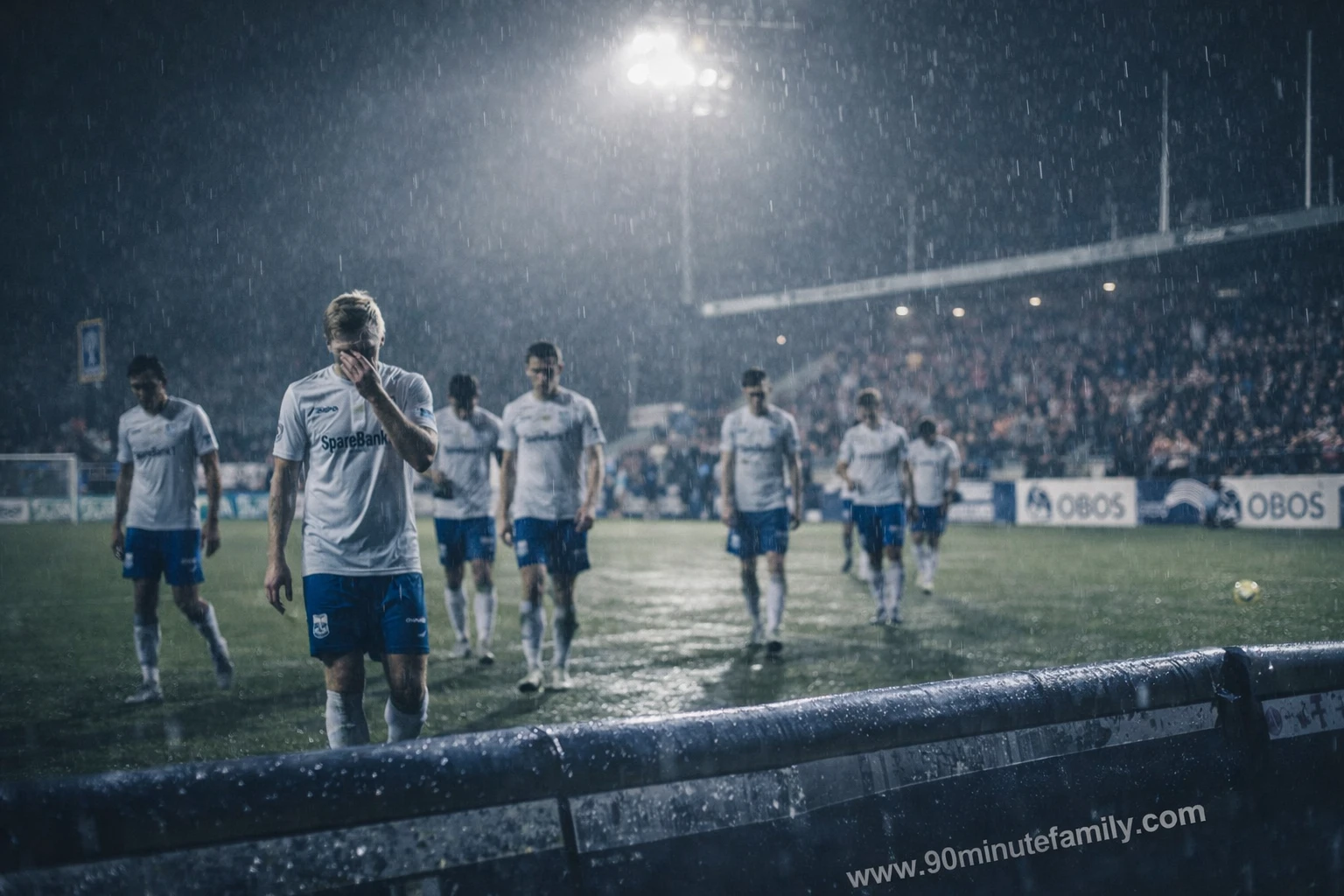
There is something special about football in the OBOS league. It lives in the shadow of the Eliteserien, and thus breathes a little more freely. Here the stands are closer, the sounds are rawer and the emotions are less filtered. Here young players become men, established names fight to keep their careers alive and the fight to avoid being forgotten often trumps the hope of promotion. And for Fk Haugesund, both are an equally likely outcome.
A predicted disaster?
Few teams received more attention than FK Haugesund last year. It may seem surprising, all the time they had to compete with both Viking's gold hunt and Bodø/Glimt's European adventure. But the attention was not about achievements that excited - it was about a team that wrote itself into the history books for completely the wrong reasons.
One point in the first eleven games. Nine points in total in thirty games. Numbers that tell the story not just of a bad season, but of a collapse. A season that could ultimately only end in one way: with a heavy, inevitable relegation.
But how could it go so wrong? And perhaps more importantly – was it possible to see it coming?
The sum of everything – in one and the same season
What ultimately sent FK Haugesund down was not a single mistake. It was the sum of many. Not just during the 2025 season, but over several years.
Nevertheless, the club chose to do what is often fatal; instead of cleaning up, they got rid of what actually worked; the best goalkeeper in the premier league, and a pair of stoppers who carried the team through a demanding season. Three players who were practically the very reason the club survived the year before.
When you also invest in an injury-plagued Runar Espejord, and at the same time believe that Bruno Leite and Julius Eskesen alone represent enough experience to carry a team, and no one in the administration is thinking about having reinforcements ready in the critical summer window, the picture begins to emerge. Yet few dared to point out the obvious; that the emperor actually had no clothes on.
The Administration – Someone had to go
One would think that such a development would lead to self-examination. And it did – to a certain extent.
Sancheev Manoharan disappeared early in the season. Sports director Eirik Opedal had already resigned. And when relegation was a fact, general manager Martin Fauskanger also chose to leave. A ship that had long taken on water finally lost almost the entire crew.
Toni Korkeakunnas stayed the longest. The Finn, who himself has been clear that he was not given the whole picture when he took over, appeared loyal – but also uncomfortable. The contract expired in 2026, but the club still chose to break it. Maybe right. Maybe necessary.
But the timing? Two weeks before the start of the season – and still without a head coach.
It's hard not to ask questions.
A past that won't let go
While the club talks about a new start, there is one thing they cannot let go of: the past.
Jostein Grindhaug is back again. The player. The coach. The sports director. Now as a scout.
With Kristoffer Haraldseid and Leif Birkeland in new key roles, this could have been a natural breaking point. A new course. A new identity.
But instead, one returns to the familiar.
Why? Very few know. But maybe we can find the answer if we follow the flow of money…?
Internal investigation – a crushing verdict
Eventually, it became impossible to ignore the problems.
An external review revealed an organization characterized by:
- Unclear roles and responsibilities
- Unfortunate overlap between board and operations
- Weak decision-making processes and informal power structures
- Low psychological security
- Missing notification channels
- Weak internal and external communication
- An experience of a closed club
In short: The problem wasn't just on the pitch.
Leif Birkeland has a background from the public sector and experience with structure and systems. That could be crucial. But he too is drawn from within his own ranks.
And that is perhaps part of the challenge.
Team of the year – young and promising?
The last few years have been tough, but one thing has been clear: As long as Selvik, Bærtelsen and Fredriksen were in place, a foundation had been laid.
When they disappeared, so did the security.
29 goals in 30 games in 2024 turned into 22 goals the following year. Numbers that make survival almost impossible.
The problem wasn't just the strikers. It was the structure around them. The lack of creativity. The absence of players who challenge space, who break patterns, who create imbalance.
Too many wanted the ball at their feet. Too few took the run from behind.
The exception was Tounekti. But he disappeared.
The time that followed was a perpetual support pass.
Defensive challenges
In recent seasons, FK Haugesund has built from the back. A solid defense, a reliable goalkeeper – and then take offensive contributions as a bonus.
Now much of that is gone.
Einar Bøe Fauskanger is considered one of the country's greatest goalkeeping talents, but is still on the bench. Everything indicates that Amund Wichne will start the season.
Otherwise, almost the entire defense has been replaced. Niyukuri will be difficult to replace. The others? Less missed.
The question is whether youngsters like Bondhus, Solheim and Hope are ready for the responsibility. Fortunately, they have the routines of teammates in central defense. Bjørnbak, Koskela and newly acquired Møller must be at work if this is to work.
But it is a brave choice, both in terms of number and age.
Maybe too brave?
Offensive bright spot
There is still hope.
Viland Andersen, Remmem, Petcho and Derviskadic add something the team has been lacking: speed, creativity and a willingness to challenge.
Hannola already showed last year what one right type of player can do to a team. Suddenly the ball went forward. Suddenly something happened.
With Bruno Leite back, the team also gains experience and breakthrough power at the center.
And then there's Petcho.
If he stays injury-free, he can be the difference. A player with an x-factor. Someone who creates imbalance. Someone who decides games.
OBOS 2026 – tight and even
Relegation often automatically grants promotion status.
But not in the OBOS league .
With teams like Strømsgodset, Stabæk, Kongsvinger, Bryne and Sogndal, this is a league where the margins are small and the level is even.
FK Haugesund has set itself an offensive goal: promotion.
Realistic? Maybe.
But that requires leadership. Structure. Stability.
And last but not least: that the right players take responsibility when it matters most.
Hope is the last thing to die
Two weeks is a long time in football.
A coach can come in. A defender can be signed. The pieces can fall into place.
And then – perhaps – hope can turn into faith.
But for now, it is limited to just that: hope.