

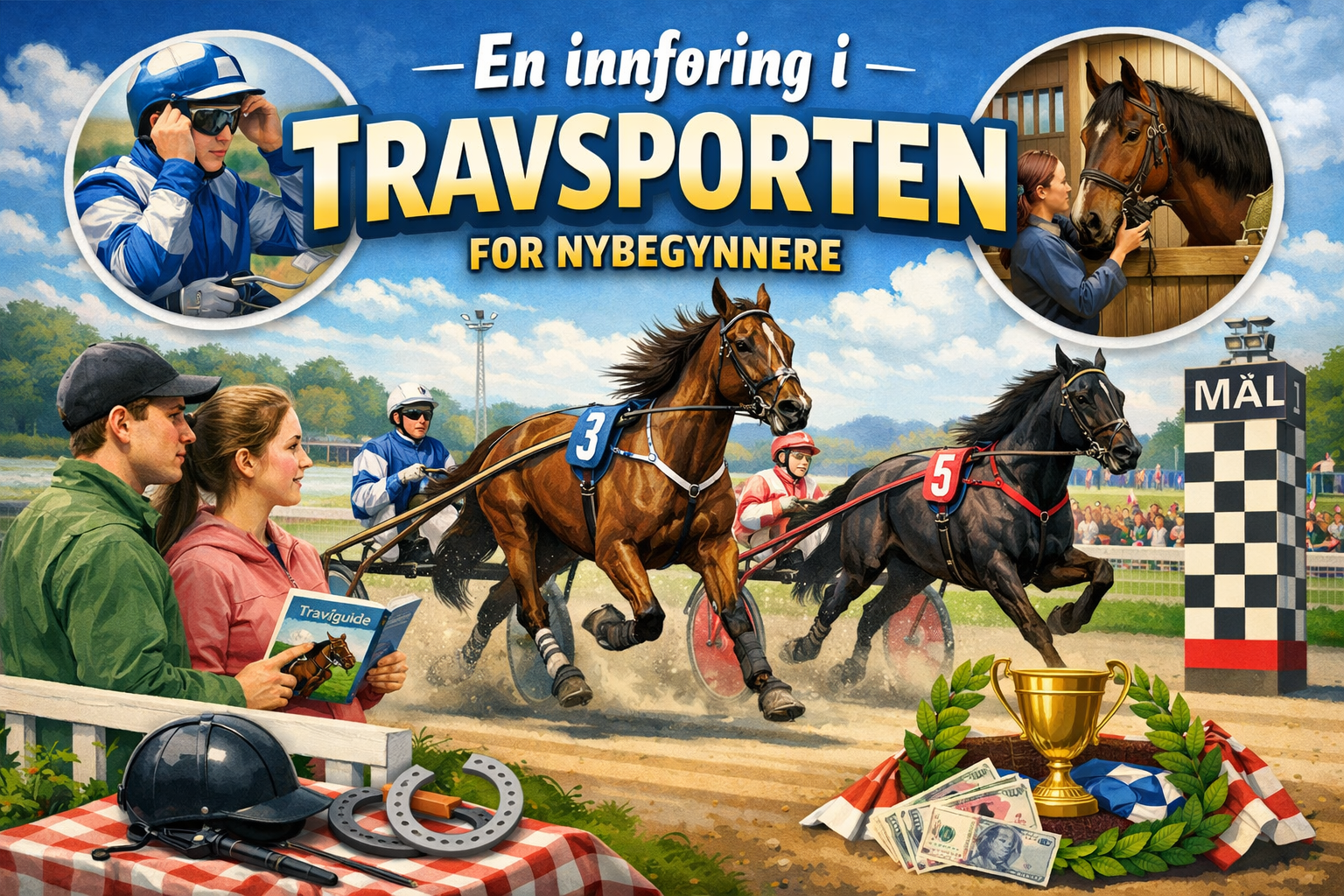

Sports, games and excitement at the racetrack
What is trotting?
Trotting is a fascinating equestrian sport in which horses pull a small cart – called a “sulky” – and compete to be the first to cross the finish line. There are two main types of trotting horses: cold-blooded trotters and warm-blooded trotters , which have different origins and characteristics. Warm-blooded trotters are the fastest, and this type of trotter is used in competitions in Scandinavia, Europe and Australia, among others. Cold-blooded trotters are mainly in action in Norway, Sweden and Finland. The horses must maintain a trot throughout the race; if they gallop, they risk being disqualified.
How a trotting race takes place
A typical trotting race starts with the horses and drivers getting ready behind the starting car (a car with “wings”/bars in front that are released at speed) or at the starting line (in a “flip start” , where the horses turn and turn in a specific formation). Once the race is underway, it is important to find the right position – either in front or behind others. Along the way, both horse and driver are challenged, and tactics play a big role. The last meters to the finish are often very exciting, and this is where the winner is decided.
Bet on the trot
Trotting is closely linked to gambling and excitement. At Norwegian trotting tracks you can bet in different ways – for example V75, V5 or V4. These are bets where you predict which horses will win or come in the best places in selected races. Many people find it extra fun to follow when you have some money at stake, but remember that it is always important to gamble responsibly. In addition, trotting is very social. Especially if you participate in a cooperative .
The atmosphere at the racetrack
Visiting a racetrack is a unique experience. You can see the horses up close, feel the excitement and hear the cheers as the favorites race across the finish line. The track often offers food, family activities and opportunities to meet both horses and drivers.
What should you know as a beginner?
- Trotting is about interaction between horse and rider, and requires both strength, speed and tactical understanding.
- Learn the most common types of games before you try your hand, and feel free to read tips from the experts .
- Keep an eye on the horses' form, the drivers and the track conditions - it can make it easier to understand the results.
- The most important thing is the experience: enjoy the atmosphere, the excitement and the joy of the sport!
Common expressions in trotting:
- Sulky : The light horse-drawn carriage in which the driver sits.
- Coach : The person who controls the horse during the race, equivalent to the “jockey” in horse racing.
- Trot : The horse's gait in trotting, where diagonal legs move simultaneously. Cantering results in disqualification.
- Starting car : Car with wings (booms) that help give the horses an even start in autostart.
- Volte start : A starting method in which the horses turn and turn in specific tracks before the race begins.
- Back track : Horses that start behind the front row, and thus have a more challenging position.
- Addition: Occurs in vaulting starts, where horses are divided according to how much money they have earned. Those who have earned over a certain amount receive an addition to the distance, usually 20 or 40 meters. This is a form of “handicap”, so that “everyone” has a chance to win the race.
- Run-up : The last part of the track before the finish line, where races are often decided.
- Back : To lie behind another horse in the race, often to save energy.
- Death's: The position outside the lead horse. Considered a heavy position, without pulling assistance and a "longer" path to the finish in relation to the leader.
- The winner's gap: The position behind the leading horse. This can often open up in the run-up and cheat the leading horse of the win.
- Favorite : The horse that has been bet on the most and has the lowest winning odds.
- Outsider/Fidus : A horse with high winning odds and less expected chance, but which can still surprise.
- Disqualification : When horse and driver are taken out of the race, often due to galloping or irregularities.
- V85/V75/V65/V5/V4 : Different types of games where you have to find the winner in several races in a row. The first number after the letter V shows how many races you have to be right to win the highest prize. If there are more numbers after the letter V, it means that there are prizes also for smaller numbers of correct ones, for example, in V85 there will be prizes if you manage to score 8,7,6 or 5 correctly, and V75 there will be prizes for 7,6 or 5 correctly. If there is only one number after the V, there is only one prize group. (e.g. V5 = only for 5 correctly)
- Single race bets: There is also the option of betting on single races, which is a great way to get excitement for small bets. Place and/or Winner can be examples of these. Place means that money is bet on a horse that you think has a chance of being among the first three at the finish. Winner : horse you have a little more faith in, and that this is the winner of the race. Here there can be a lot of excitement for cheap money. Bets from 5 kroner and up.
Summary
Trotting brings speed, emotion and community, whether you follow the races at home or visit the track. For beginners, it's easy to get involved – whether you get hooked on the sport, or find it exciting to try your luck with games. There's room for everyone here, and you don't need any prior knowledge to join in the fun on the track.