

A critical and tactical review of a match, Denmark should have won in their sleep
There are those international matches, where you are left with the feeling that something went wrong. But you can't quite explain what.
And then there are matches like this one.
Where the error is on the green screen from the first minute:
incorrect player selection, incorrect structure, incorrect match between plan and player types.
Denmark plays 2-2 against Belarus in the Park, and you can almost hear the rest of football Europe grumbling on Denmark's behalf.
Starting lineup
Schmeichel
Kristensen – A. Christensen – Vestergaard – Dorgu
Højbjerg – Nørgaard
Isaksen – Eriksen – Damsgaard
Wind
The formation itself is not the problem.
A 4-2-3-1 is a flexible and familiar structure, and Denmark has previously played it with great success.
The problem arises when the requirements in the formation do not match the types of players chosen for the roles.
Tactically, a 4-2-3-1 requires, among other things:
- one fast center back, who can cover large spaces, especially when the backs are tall
- a left back, who can balance between offensive runs and defensive stability
- a dynamic 8, who can tie the midfield together in the breakthrough game
- a 10 in fighting form, who can create tempo and variety
- a nine, which threatens the depth and can create movement against a compact opponent
In Denmark's line-up, several of the decisive parameters were not met:
- Vestergaard is not a centre-back, who can cover back space alone in a four-back chain.
- Dorgu is strong offensively, but leaves large spaces, which only a fast partner can compensate for.
- Nørgaard is a six type, not the dynamic 8, the formation requires in this match.
- Eriksen lacks the fighting form and pace to be the creative engine in the central 10's role.
- Wind does not threaten the back chain and thus provides no depth, which is crucial against a low-ranking team like Belarus.
In other words:
The formation's principles are good. But the player composition does not support them.
And when the roles are not filled with the right profiles, the system loses both balance, dynamism and offensive variety.
❌ Dorgu – an offensive weapon with a safety flaw behind
Dorgu has the potential to become one of Denmark's best left backs for many years.
But he is very young.
And he plays with the courage that young players often have:
- forward
- forward
- and forward again
The problem?
When he walks, he walks.
And when Vestergaard stands behind him, the Danish left side is an open window in April . It drags.
Result:
Andreas Christensen is left as a lone guard on night duty in Bilka Odense.
It's impressive, he doesn't ask for overtime pay.
2. The middle ground – When stability meets stagnation
✔️ Højbjerg – the only one who looked like a football player in fighting form
Solid, disciplined, hardworking.
He stood in the way, he distributed the game and he showed leadership.
He is not the problem.
⚠️ Nørgaard – good player, but wrong match
Nørgaard is not a bad footballer.
He is actually an outstanding structure carrier in a team, which must defend and control space.
But here Denmark should:
- break down
- create pace
- find space
- make breakthroughs
- play against a compact 11-man low block
And Nørgaard offers neither.
Here comes the anecdote:
When people asked during the break: "Why isn't Hjulmand playing?" , one could hear answers such as:
"He has a quarantine risk."
Yes. But the match was so important that a win would require Denmark to lose 0-6 to Scotland in the next match to go out.
It only happens in Football Manager at the hardest level, if you manage San Marino.
➡️ Hjulmand was the perfect replacement for Nørgaard.
➡️ And he sat on the bench.
➡️ Because the coach was afraid of quarantines .
It's poor workmanship.
❌ Eriksen - the heart says yes, the body says no
It almost hurts to write.
Eriksen is one of Denmark's biggest football minds ever. And I, as a native of Fynbo, and an old opponent against the very same man in Middelfart, can really like Christian, and everything he has stood for in the national team.
But the brain cannot compensate for:
- lack of fighting form
- lack of pace
- lack of acceleration
- missing output
- lack of rhythm
He has played so little football since the spring that it is almost ironic that he is starting in one of the most important matches in the qualification.
It became predictable, it became slow, and it became easy to shut down.
That is the coach's responsibility - not the player's.
3. The Offensive – A symphony without tempo, without depth and without logic
❌ Wind - like putting a wrong piece in a LEGO set
Wind is a skilled player.
But he is for spaces.
For play.
For combinations.
He is NOT for:
- deep run
- speed
- pressure
- cutbacks endings
- running behind a compact chain
And he is no match for a box player against three physical belts in the Belarus defense.
Asking Wind to threaten rear room is like asking a Toyota Aygo to win Le Mans.
It's not happening.
✔️ Isaksen – talent, but without fighting form
He has speed.
He has 1v1.
He has courage.
But he has played so badly at club level due to injuries that he cannot go in and wreak havoc from the first to the last minute.
He should have come in against tired legs. Drevet played with the opponent, and put important players in the box in the scene. But they also came in too late.
❌ Dreyer – 22 goals, 16 assists, and gets 2 minutes
This is pure coaching error.
When sitting with a player:
- in the shape of a career
- who plays week after week
- in exactly the place where Denmark has the problem
- who makes measurements on the assembly line
- and you choose to give him 88 minutes on the bench
… then it is not a mistake.
It is a decision.
And a bad one at that.
✔️ Damsgaard – the only creative spark
Damsgaard tried.
He:
- drove the ball
- created spaces
- train ran
- searched combinations
- showed courage
- kicked on goal
He was one of the few who resembled a player with a plan. And what a goal he got!
4. The depth game - when the coach misunderstands the principle
Even when Belarus is with 11 men in their own box, deep runs are important.
Not because the space exists - but because it CREATES space.
Wind does not make deep runs.
Biereth and Dreyer do.
When you have no depth, you get:
- static rear chain
- compact block
- no spaces
- no movement
- predictable game
- closed match picture
- zero chances
Depth run is not a luxury tool.
It is a prerequisite for opening opponents.
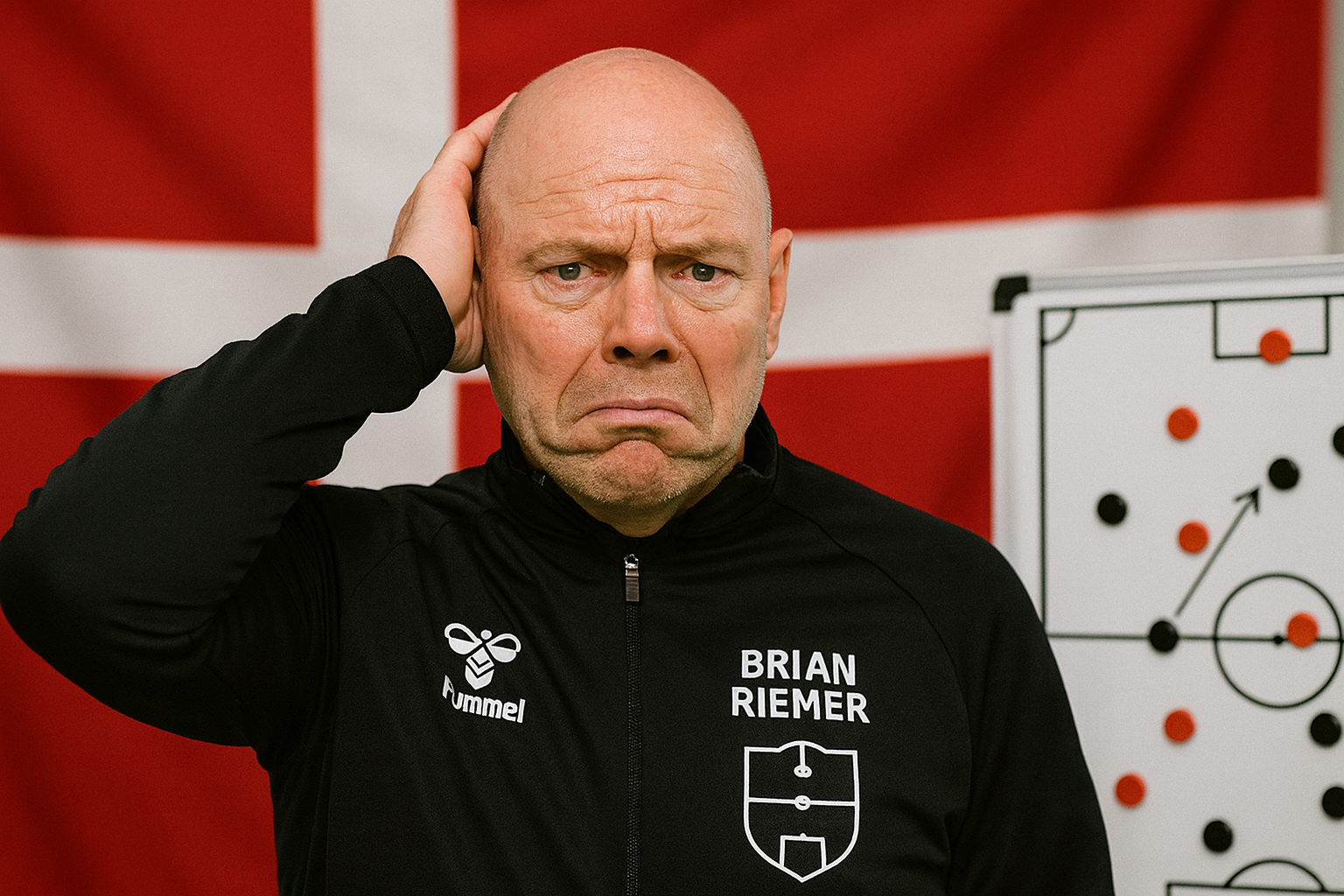
Riemer ignored it completely.
Conclusion - You don't become a champion if you don't dare to bet
This was the match, Denmark was going to win.
Not just should win.
SHOULD win. BIG.
Riemer did the opposite of betting.
He played "safe".
But safe in football often means the opposite.
Denmark chose:
- out-of-form players
- miscast roles
- a structure that does not fit the profiles
- a defensive midfield against a low team
- a slow center back without protection
- not enough depth
- no attack on second ball
- no creative risks
- no brave substitutions
- no variation
Riemer coached the game, as if Belarus wanted to play against itself.
But that's not how you win.
This is not how to GUARANTEE a place at the WC.
And as they say:
You don't become a master of avoiding losing.
You become a master of daring to win.