
Analysis of:
Bodø/Glimt – Fire

Written by: André R. Fonbæk
Analysis Information
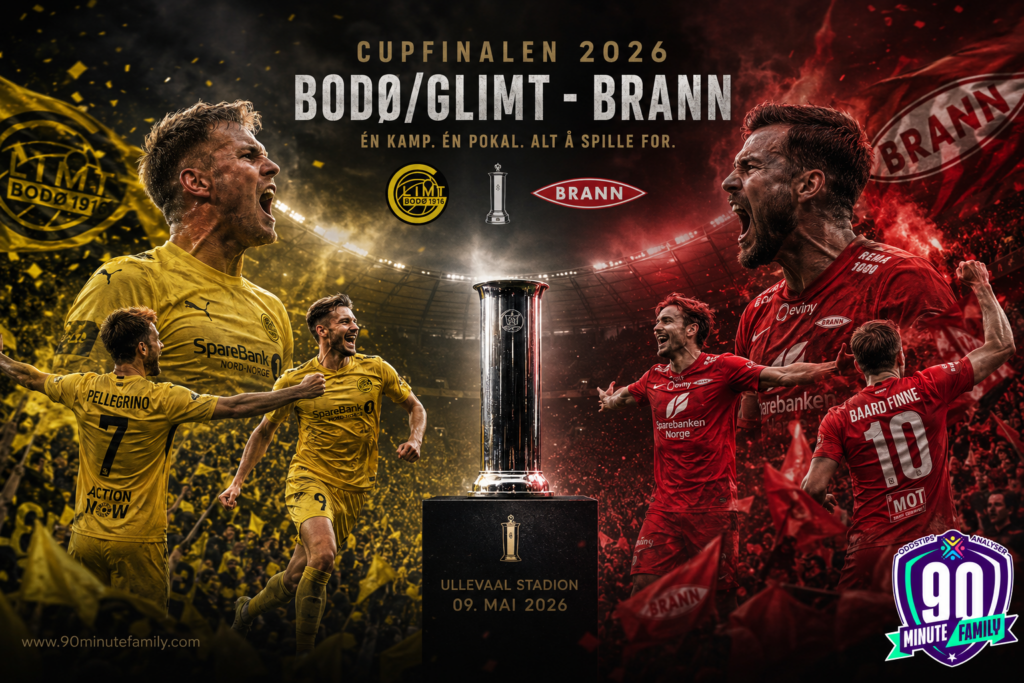
Cup final 2025/2026
The Norwegian Cup was once the very heart of Norwegian football. The autumn was built around the cup matches, the stands were full, and the tournament had its own dramaturgy that differed from everything else in Norwegian sports. After the change in the cup format, much of this has disappeared, for which we can thank the NFF . The tournament appears more fragmented, the schedule is tighter, and several clubs are forced to prioritize between the series and the cup in a completely different way than before.
Nevertheless, the nerves are still alive when the matches are first played, and especially in a cup final. Because even though the format has changed, the feeling around the big moments has not disappeared. The match between Brann and Bodø/Glimt is still about far more than just a trophy.
There is also significantly more at stake than just the King's Cup. Bodø/Glimt has already secured a European place in the autumn through the league. This means that if Glimt wins the cup final, the last European place automatically goes to Lillestrøm SK as the winner of the 2025 cup. Should Brann win the final, however, the Bergen team will meet Lillestrøm in a super cup final where the winner secures the last Norwegian place in Europe next season.
Thus, the final is not only about prestige and history, but also about enormous economic value. European games mean many millions in club coffers through UEFA money, ticket revenue, sponsorship values and increased exposure. At a time when the differences in Norwegian football are increasingly widening economically, a single match can have significant consequences far beyond the trophy itself.
Bodø/Glimt – The machinery from the north is hunting for new gold
For Bodø/Glimt, the final is about continuing the dominance they have built up in recent years. Glimt has redefined Norwegian top-flight football with its intense and offensive style of play, and the club has created a winning culture where every final and title match is almost expected to end in gold.
At the same time, Glimt also knows how demanding cup finals can be. Such matches often take on a life of their own, regardless of form and table situation. That is precisely why the ability to handle the psychology and rhythm of the match becomes extremely important.
Glimt enter the final with the same identity that has made them Norway's strongest team in recent years. They play with high intensity, great movement and significant risk offensively. The goal is to dominate possession, create superiority in the middle and force the opponent to spend large parts of the game without the ball.
Perhaps the most interesting statistic is how often Glimt matches open late. In the last ten meetings between them in Bodø, approximately 65 percent of the goals have come after halftime. Several of the matches have exploded in the last half hour, especially when the opponent starts to tire and Glimt turns up the pace even further. Then the spaces become larger, the transitions more dangerous and the matches much more open.
Fire – Bergeners come with new self-confidence
For SK Brann, this final is about much more than just a trophy. The Bergen team had a more unstable start to the 2026 season than many had expected, and the team occasionally lacked both rhythm and offensive flow in the early rounds. However, in recent weeks, the arrows have clearly pointed upwards again.
Brann now enters the final with renewed confidence after two very strong league matches. First, they surprisingly crushed Tromsø 5–0 away, before Fredrikstad were beaten 3–1 at home at the Stadion. The performance in Tromsø in particular sent a clear signal of the level that still lives in this team when the intensity, pressing game and transition game are right.
A cup triumph will not only bring silverware, but could also change the whole feeling about the season. Finals often have that effect. One match can turn the mood around a team, create new energy and give faith in the project again. At the same time, Brann knows that the consequences of this match extend far beyond the trophy itself, both sportingly and financially.
In terms of play, Brann still has many of the qualities that make them unpleasant to face in individual matches. The team is physically strong, aggressive in the pressing game and very direct when they win the ball high up the field. When Brann gets the game into its own tempo, they are able to put opponents under constant pressure, especially on home soil. At the same time, the Bergen team can still become vulnerable when the games lose structure and the gaps become larger defensively. It is especially challenging against a team like Bodø/Glimt, who may be the best in Norway precisely when the games open up in the second half.
The history against Glimt also shows a clear pattern. Several of the recent meetings in Bergen have started relatively controlled before the games have gradually opened up after the break. This also fits well with the historical picture we often see in Norwegian cup finals, where the intensity, risk and number of chances increase significantly throughout the match.
Conclusion – The match that could explode after the break
This year's cup final is about much more than just prestige and history books. There are also enormous financial values at stake. European games mean millions in club coffers through UEFA money, ticket revenue, sponsorship deals and increased exposure. At a time when the economic differences in Norwegian football are growing, a single match can have significant consequences for the clubs' development in the coming years.
At the same time, there are many indications that this final could follow the pattern we have seen so many times before, both in Norwegian cup finals in general and in the meetings between Brann and Bodø/Glimt in particular. Historically, these matches often start in a controlled manner and with relatively low risk. The nerves are clear, the intensity is high, but few want to take the first big chance early in the match. As the match develops, the dynamics gradually change. The tempo increases, the spaces become larger, and especially beyond the second half, the matches often take on a much more open feel.
This is also where the statistics get interesting. If you look at both the last 50 Norwegian cup finals and the last head-to-head matches between Brann and Bodø/Glimt, the tendency is very clear. It is clear that most goals come after half-time. When tired legs face increasing risk and one of the teams has to chase a goal, these matches have time and again developed into far more open and dramatic matches in the second half.
Norway at 18:00: Bodø/Glimt – Brann: Most goals in the second half (2.07)